
Skip to main content.

Smithsonian National Museum of Natural History
{search_item}
Henry the Elephant inside the Museum Rotunda

Getting to the Smithsonian National Museum of Natural History

By subway: Take either Metro's Blue or Orange subway line to the Federal Triangle Station. An escalator and an elevator at 12th Street are one block North of Constitution Avenue and one long block West of 10th Street.

Parking

There is limited free parking on the National Mall. Mall parking is under the jurisdiction of the National Park Service. Available spaces fill quickly, especially during the summer and holidays. On Madison Drive there are three parking spaces at the East end of the Museum and two parking spaces in front of the Museum for people with disabilities. These are standard curb spaces on the left side of a one-way street.

However, the National Mall entrance, from Madison Drive, is not accessible. Visitors using wheelchairs must go around the building to the Constitution Avenue entrance, located on the North side of the building. The District of Columbia has not designated any parking spaces on Constitution Avenue for people with disabilities. There is a passenger drop-off area at the Museum's Constitution Avenue entrance. You can view and print an accessibility map of the Smithsonian museums on the National Mall.

The closest parking garage to the National Museum of Natural History with accessible parking spaces is in the Ronald Reagan Building (14th Street and Pennsylvania Avenue, NW)

Entrances

At the Constitution Avenue entrance, there are ramps and automatic doors. The entrance on the National Mall side of the building is reached by two very long, steep flights of steps. The doors at the National Mall entrance are very heavy.

General Information

By law, service animals and power scooters are allowed in the Museum. The TTY number for the National Museum of Natural History is (202) 633-9287.

All video presentations within exhibitions are captioned; most are open-captioned.

Baird Auditorium contains audio loop amplification for the first 12 rows of the center seating section. Visitors may access the system by activating the telecoils in their hearing aids.

The Johnson IMAX® Theater is equipped with a multichannel infrared system that provides audio amplification and audio description. Headsets are available at the box office. The theater also offers closed-captioning using Rear Window© technology.

There are Braille labels in the Discovery Room.

Tactile museum experiences are provided for all visitors to the Discovery Room and the Insect Zoo. Interpretive carts that roam the exhibit halls on Monday through Friday during October-April feature touchable objects. Hours for each of these areas vary; ask at the information desks in the Constitution Avenue lobby on the ground floor or in the Rotunda on the first floor. Or call (202) 633-1000 (voice) or (202) 633-5285 (TTY) for hours and locations.

There is a Visit Planning kiosk featuring information on what is happening at the Museum that day. It is located on the first floor near the museum shops and offers an audio version of the visually-presented information.

The Museum has six elevators. Two of them—one at each entrance—are operated by an attendant. The other four elevators are self-operated and accessible.

Baird Auditorium is not completely accessible to visitors using wheelchairs. However, people using wheelchairs are welcome in the auditorium and space is available along the back aisle.

There is dispersed accessible seating, as well as companion seating and chairs with flip-up arms, in the Johnson IMAX® Theater in the Discovery Center.

Wheelchair Availability

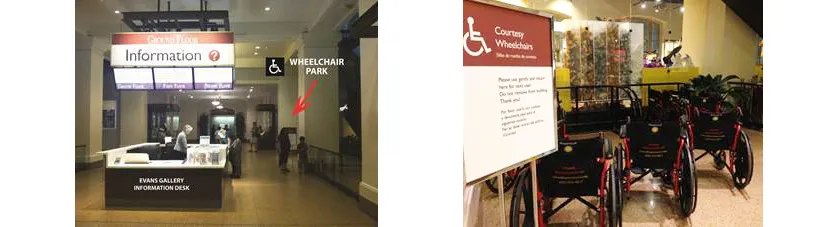
The National Museum of Natural History has wheelchairs that may be borrowed, free of charge, for use within the building. The wheelchairs, which are all manually operated, may not be taken outside of the Museum.

The wheelchairs are available on a first-come, first-served basis. To borrow a wheelchair, go to the Museum's information desk and request a loaner. The information desk attendant may help you directly or send you to the nearby Security Desk. You will be asked to leave identification until you return the wheelchair.

If you prefer to rent a wheelchair for all-day use between museums, below is a list of vendors in the area who can assist you. This list has been compiled from the Yellow Pages of the Washington D.C. phone book for your convenience. The list may not include all businesses that rent wheelchairs or reflect the current status of a business. Businesses listed are not endorsed or recommended by the Smithsonian Institution.

Division, EKA Health and Mobility Systems, Inc.
9151 Hampton Overlook
Capitol Heights, MD
(301) 499-1000
Toll-free: (800) 835-2002
scooters, manual and power wheelchairs

Area Access Inc.
8117 Ransell Road
Falls Church, VA
(703) 573-2111
Toll-free: (800) 333-AREA
Website: http://www.areaaccess.com
scooters

Mobility Solutions Inc.
9343 Fraser Ave.
Silver Spring, MD 20910
(301) 650-2290
Toll-free: (800) 519-0035
Website: http://www.1mobilitysolutions.com
Email: mobility@1mobilitysolutions.com
scooters

Spectrum Medical Inc.
8820 Brookville Road
Silver Spring, MD
(301) 587-2992
manual wheelchairs

All the businesses listed will deliver to and pick up from your hotel or residence.

Food Services

On the lower level of the Discovery Center in the West Court of the West wing is the Atrium Cafe, a 600-seat cafeteria. It is fully accessible to visitors using wheelchairs.

Restrooms and More

There are accessible restrooms in the East Court of the East wing, including a companion care restroom. There are also accessible restrooms on the ground floor near the Constitution Avenue entrance.

There are moderately accessible restrooms in the East and West wings on the first floor and in the West wing on the second floor. Other restrooms are inaccessible.

The National Museum of Natural History has a unisex or companion care restroom in the new East Court off of the Rotunda.

All banks of public telephones contain at least one at wheelchair users' height. There are accessible water fountains in the ground floor restrooms. A public TTY is at the bank of telephones on the second floor of the East Court near the ladies restroom.

If you need to use the health unit to change catheters or rest due to your disability, the Museum may be able to accommodate with this service. Contact the Accessibility Program for information: (202) 633-2921 (voice), (202) 633-4352 (fax), or email Access@si.edu.

Tours and Publications

Visitors may obtain information about scheduling tours and programs or arrange tours designed for visitors with disabilities by writing to:

National Museum of Natural History
Office of Education
Washington, D.C. 20560-0158
Or call (202) 633-1077 (voice) or (202) 633-9287 (TTY).

Accessibility features are marked on the Museum's floor plan.

A raised-line map of the National Mall is available for use at the information desk.

If you would like to have a sign language, oral, or cued-speech interpreter or Realtime captioning for an event, you should call (202) 633-1077

(voice) or send an e-mail to ramsdell@si.edu with your request at least two weeks in advance of the program you plan to attend. Call the organization sponsoring the program and tell the staff what services you will need. Please be specific. For example, if you would prefer an ASL interpreter rather than a PSE or Signed English interpreter, be sure to tell the staff that specific information. Because the Museum does not have its own staff interpreters we require advance requests to hire them from agencies.

If you would like other accommodations, such as audio description, reader services, alternative formats of publications, assistive listening systems, or any other services, please call the sponsoring organization and place your request at least two weeks before the event.

If you do not know which organization is sponsoring the program, contact the Accessibility Program at (202) 786-2942 (voice); (202) 786-2414 (TTY); (202) 786-2210 (fax); zeibarthb@si.edu.

The Smithsonian will provide interpreters only for scheduled Smithsonian tours or programs. Nearly all of the exhibition videos are captioned or have scripts next to them.  Audio tours have scripts available. Exhibitions are accessible to people who are deaf or hard of hearing.

A "Touch and Hear" guide for visitors who are blind or have low vision and a large-print map with directions to touchable exhibits are available at the information desk.

For a large-print version of the Museum's calendar of events or other Museum publications in alternative formats—audiocassette, Braille, large print or computer disk—call (202) 357-4014 (voice) or (202) 633-9287 (TTY). The time it will take to fulfill a request will depend on the length of the text being requested and current availability.

The Accessibility Program's Voices to Access 2000 project audio tapes Smithsonian publications for use by people who cannot use standard print. To obtain a list of available publications or to request a specific Smithsonian publication for recording, please call (202) 786-2942 (voice) or (202) 786-2414 (TTY).

Other publications, including exhibit scripts, are available in Braille, in large print, and on disk. Call the organization responsible for the publication to find out what formats are available. If you do not know the name of the organization, call the Accessibility Program at the numbers listed above.

[ TOP ]