|
![]() |
|||||||||||||||||
|
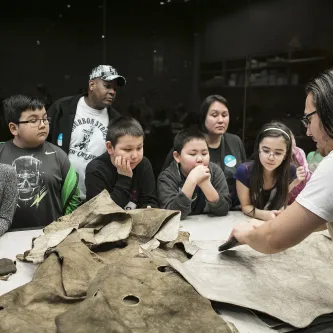
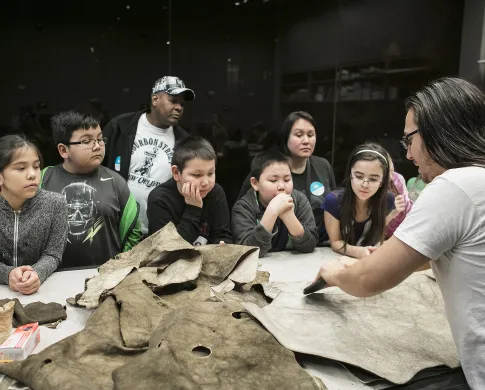
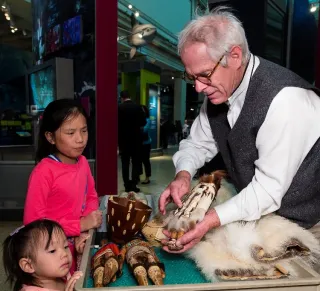
Repatriation as a Guiding Principle for the Arctic Studies Center The passage in 1990 of the Native American Graves Protection and Repatriation Act (NAGPRA) emerged from the same social and political climate that now finds museums throughout the United States reconsidering their roles vis-a-vis Native Americans. Coincidentally, many Native communities are experiencing a burgeoning awareness of their cultural heritage, evidenced by the construction of local and regional cultural centers and by the growth of initiatives like Keepers of the Treasure, an organization of Native Americans concerned with the preservation of their physical patrimony. In the North, many Native villages still retain a strong community identity. This identity is often based on the continuance of traditional hunting and fishing subsistence economies. It is also reflected in an ideology that includes a special reverence for elders who retain their cultures' traditional ecological knowledge and spiritual reverence for the land and animals on whom life depends. These shared sentiments are leading communities throughout Alaska to develop their own cultural preservation programs, initiatives that include an appreciation of 19th-century material culture, much of which now resides in museums throughout the world. The Arctic Studies Center (ASC), located in the Anthropology Department at the National Museum of Natural History, was created in 1988. The program embraces the tripartite mandate of the Smithsonian's contributions to knowledge through research, exhibition and educational outreach programs. All three of these agendas are realized by the ASC commitment to "community anthropology," which seeks to combine the knowledge and experience of ASC personnel with objects in the Smithsonian's collections and Native community interests and expertise. This program is a logical extension of Smithsonian commitment to Arctic and subarctic peoples that uses the materials in the national collection to celebrate the accomplishments of those Native peoples. The concept of repatriation, which encompasses the return of knowledge and awareness of objects in museum collections to Native communities from which they derive, seeks common ground between Native Americans and museums holding title to large ethnographic collections. An example from Labrador and one from Alaska illustrate this broad interpretation of the repatriation concept. Pathways Funds for a six-week field course in archaeological method and theory was acquired through "Pathways," a training program supported by the province of Newfoundland-Labrador. The course provided Innu students with the skills to work as technicians and crew members on archaeological research projects and gave them an introduction to cultural resource management programs and philosophy. Community involvement was an essential feature of the Pathway program. An integral feature was the recognition of the importance of the skills, knowledge and memories of lnnu elders, who were invited to the classroom. The science of archaeology is a Western method of constructing knowledge about the past. The course was designed to include both the Western "scientific" discipline and the wisdom and knowledge of the Innu, based on traditional practices, observations, myth, and memory. After ten days in the classroom, the students spent nearly a month working at a site. Excavation revealed the remains of old tepee structures with central hearths. A wide array of late 19th and early 20th century artifacts, including hunting and fishing paraphernalia, tobacco-related products, knives, cookware, medicinal containers, molasses jugs, combs, beads, and coins, was recovered. The final phase of the program was a presentation to the community on the results of the project. The Pathway participants spent a week cataloging and conserving the excavated objects, and preparing an exhibition and open-house for the community. Not only did the Pathway project represent an exciting development in archaeological research in Labrador, it provided a way for young Native people to work closely with community elders, and instilled pride by revealing a rich, exciting history that is their legacy. For the Arctic Studies Center, Pathways provided a model of collaboration between Native people and Smithsonian archaeologists. Smithsonian Ethnographic Collections Skeletal Materials Although we now recognize that Hrdlicka's collecting techniques would not meet either the scientific or ethical standards of today, we also realize that his contributions to the understanding of human variation are the foundation of modern physical anthropology. The techniques he developed and the standards he established provided guidelines that are still in use today, half a century after his death. The materials collected by Hrdlicka from Alaska and elsewhere have been used to help establish cultural continuity at archaeological sites; to assess diet, health and stress of early peoples; to provide clues to human migration patterns and ethnic identity; to provide information on growth and development; to document pathological conditions affecting populations; and to provide a basis for comparison in forensic cases. Many of these studies have directly benefited the Native people of Alaska, by providing them with information about the daily lives of their ancestors, by helping to establish their legal status, and by confirming their heritage and cultural identity. Some of the Alaskan skeletal material from the Smithsonian collections has been repatriated, but Hrdlieka's initial measurements and documentation of morphological traits still exists for future research. Conclusion For Further Reading on Repatriation Stephen Loring - Arctic Studies Center This article originally appeared in AnthroNotes - National Museum of Natural History Bulletin for Teachers, |
|||||||||||||||||