|
|
Narwhal Tusk Research
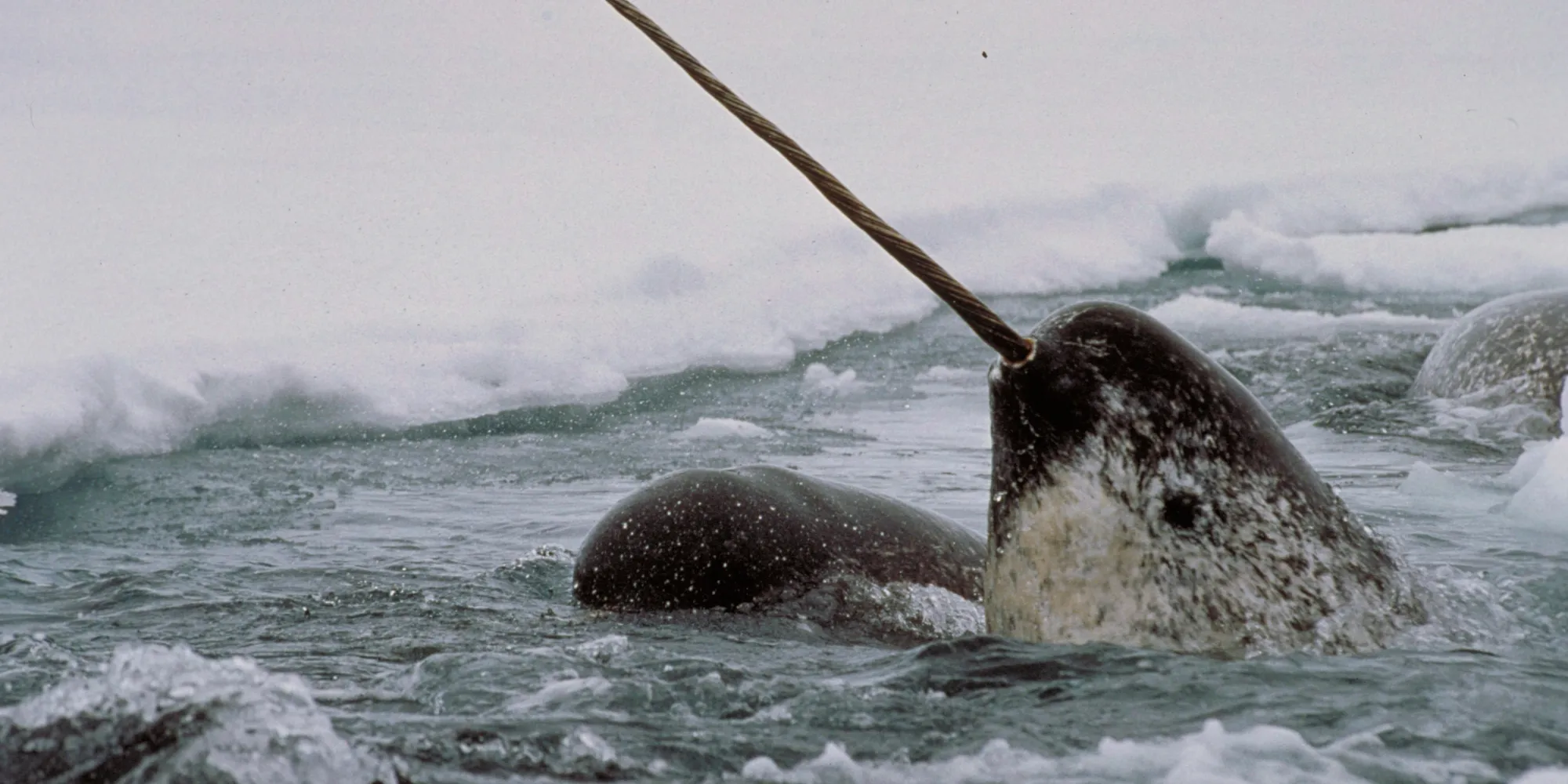
Introduction The narwhal tooth has long fascinated sea explorers, scientists and aristocracy. The legendary but real spiraled tusk, often confused with the legendary but entirely unreal spiraled tusk of the mythical unicorn has found its way into the books of scientific rarities and mythical tales. Researchers have proposed myriad theories to explain a tooth that extends six to nine feet from the upper jaw of this arctic whale. Still, considerable debate surrounds the studies attempting to explain its evolution and purpose. Throughout history, the narwhal tooth has inspired legend and lore. So prized was the fabled tooth of the unicorn that Queen Elizabeth in the 16th century paid 10,000 pounds for one, equivalent to the cost of an entire castle. The tooth is revered by many cultures around the world. In Artists know the narwhal for its unique association to the famous Unicorn Tapestries.
The Lady and the Unicorn, Plates from the Centered on the mythical creature with the single horn protruding from its head, the unicorn story traces a myth as unique as the animal that gave it life. The Greek physician Ctesias, in the 8th century B.C., told of a creature from Scientists, equally intrigued, support author and explorer Ivan T. Sanderson's comment on the narwhal as being “the most extraordinary of all living mammals.” It has retained its legendary character because of its remote and harsh inaccessible living area, and because it has what many scientists describe as the most unusual tooth in nature. Narwhal teeth contradict many of the findings seen in other mammals. Among them is the spiral nature of the tooth, and an elongated left tooth measuring up to three meters which is usually characteristic of males.
The World of the Arctic Whales Belugas, Bowheads & Narwhals, Stefani Paine, Sierra Club Books ©1997 Whales in general exhibit an unusual array of teeth and mouth organs, which have puzzled researchers. Many toothed cetaceans have no upper teeth and the lower teeth are of questionable use. Sperm whales, for example, have only soft tissue sockets that receive the 18- 25 lower teeth on each side of the jaw. The strap-toothed whale has two oversized lower teeth that can completely wrap around the upper jaw restricting its ability to open. Contrary to the more common finding of lower teeth, the narwhal tooth is reported to be an upper left front tooth of the male, the right usually remaining imbedded in the jaw. These varied expressions of teeth in whales are not well understood as they are difficult to study. Why does the narwhal exhibit such an unusual array of dental traits, and how can we explain them? Investigators in the fields of dental research, marine biology, genetics and mathematics have been assembled to examine these questions. Frozen narwhal tissue has been analyzed at The Biostructure Core Facility at The Forsyth Institute, and Harvard School of Dental Medicine and examined by CT and MRI scans at the Johns Hopkins Medical School, the National Institutes of Health and Woods Hole Oceanographic Institute. Findings from the scans help determine 1) basic anatomical soft tissue structure and morphology of the head region currently not well documented, 2) nerve pathways in the head region, 3) inter-relationships between different organs and tissue in the head e.g., the tooth and brain, the tooth and nerve pathways to the ears, 4) histology, and cell formation patterns of the tooth, and 5) understanding the pulpal tissue of the tooth and its relationship to the dentin and to structures at the base of the root. Radiographs, and T-scans, a 3-D high resolution laser surface scanner recently developed by Steinbichler Optotechnik, were utilized for recording data of skeletal samples and teeth from museum samples housed at the Smithsonian Institution. Research will begin on a molecular level finding the gene responsible for the tooth and genetic molecules that will uncover the mechanism for the trait expression. Micro structural analysis of the dental tissue has been examined and reported as well as the formation patterns of these developing tissues. The structure of hydroxyapatite crystals will be examined as they relate to the piezoelectric effect and the possibility of an electric field or potential created around the tooth's surface. Gross anatomy of the head and tooth will also be documented to differentiate males and females both with and without teeth as well as double toothed specimens. Microanatomic and histologic examination will reveal functional structures within the tusk hard tissue, and sensory cells contained within the pulpal tissue. Analysis of the tooth spiral will be examined as it relates to function and to other spirals in nature.
Descriptions and speculation about the male tooth as a weapon of aggression or defense, hunting implement, sexual display organ, and ice breaking tool are noted in the literature. Breaks in the tip of narwhal tusks have also been observed and used as evidence to support such findings. However, stress from such activities as ice breaking could significantly impair the tooth and the thin bony skull plate that supports the large, heavy, and awkwardly protruding tooth. Jaw plate fractures have not been observed or cited in the literature through the precedence of broken tusks has been recorded and estimated at about 30%. Still, evolutionary factors would favor a better-developed bony plate to support a tooth used in situations of significant stress and trauma. Rather, the possibility of the tooth as a probe seems more likely. Information and observation on the electrophysiology of the tooth will be gathered including the relationship to electric fields, acoustic signals and echolocation, and temperature control for the whale. Any proposed theory must address the prevalence of the elongated tusk primarily in males.
Observations will be collected in three ways. First, skeletal material housed at museums in the Narwhals defy most of the general principles attributed to the teeth of whales and mammals in general. First, they exhibit an unusual counterclockwise spiral. Second, they represent the most unusual example of sexual dimorphism in teeth. The elongated upper tooth is characteristic of males and seldom occurs in females. Third, narwhal teeth represent one of the most extreme examples of directional asymmetry. The term defines a difference in size and shape of what would normally be symmetric organs such as kidneys or eyes. In the case of the narwhal, the two teeth would normally be observed as symmetric. Yet, the right tooth imbedded in the upper jaw is less than one foot, while the left tooth protrudes through the bony plate of the skull and upper lip extending over six feet. In rare instances, a double toothed narwhal exhibits two elongated teeth both having a counterclockwise spiral. Although in this case, the teeth would be symmetrical in size, they are asymmetrical since the spiral of the right tooth should be a mirror image or clockwise. The asymmetry of narwhal teeth is thus exhibited in both size and morphology. Why does the narwhal have such an unusual display of teeth? The answers to these questions will likely help researchers understand the teeth of other mammals including humans. For example, information gathered from the study of sexual dimorphism in narwhal may prove useful in understanding more subtle sex differences of teeth in other mammals including humans. Such insight could be valuable in forensic cases, and for establishing new identification markers for human teeth. The upper plate of bone supporting the elongated left tooth of the male is barely thicker than the diameter of the root. In addition, the weight of the male tusk is several times that of the supporting bony plate. Results from this work will help address the question of how a thin, proportionately small jaw plate of bone can generate such a large, heavy, and seemingly unsupported tooth. Prior work on the paddlefish and platypus suggests electrical sensors used to detect food sources may be present in other fish and marine mammals. Thus the possibility of an electric field surrounding the narwhal tooth will be examined. Its use as a probe for myriad purposes including hunting and navigation may provide an unusual mechanism and purpose for the narwhal and may lead to findings about teeth in other marine mammals. Such a theory is also supported by the potential for distorted hydoxyapatite crystals in the spiral formation of the tooth creating an electric potential during movement. Much of the current documented information about the narwhal tusk needs to be updated or corrected. The very classification of narwhal teeth as incisors or canines is debated, as are the comments and speculation about the purpose and function of the tooth. Skull and jaw anatomy, and gross anatomy of the head region will be described and added to the limited published work. directional asymmetry — “Dissimilarity in corresponding parts or organs on opposite sides of the body which are normally alike.” Directional implies the dissimilarity consistently affects one side.” (Dorland' s Illustrated Medical Dictionary, 24th Edition, W.B. Saunders Company, 1965) horn — “a non-deciduous excrescence, often curved and pointed consisting of an epidermal sheathe growing over a bony core and on the heads of animals serving as a weapon of offense or defense.” (Oxford English Dictionary, 1971) sexual dimorphism “The development of physical and other differences between the sexes of the same species, especially when this difference extends beyond the reproductive organs to overall size, color, and the development of special features.” (Encyclopedia of Marine Mammals, William F. Perrin, Bernd Wursig and J.G.M. Thewissen, Academic Press, 2002, p.1367.) tooth — Its derived meaning relates to function rather than form, and in its pure form describes a conical or pyramidal elevation regardless of its substance. Horn-like teeth originate from the ectoderm while teeth in vertebrates are formed from both ectoderm and mesoderm. The teeth of most vertebrates consist primarily of dentin. This layer may be covered by enamel in the exposed tooth and by cementum in the root portion which is lodged in bone. However, these layers do not define nor do they exist in all animal teeth. (Comparative Odontology, Bernhard Peyer, University of Chicago Press, 1968, pp. 9-12.) tusk — “an extremely large tooth projecting beyond the lips.” (Dorland's Illustrated Medical Dictionary, 24th Edition, W.B. Saunders Company, 1965
A preliminary investigation was completed in May and June, 2002 to plan and begin development of this expedition. Many aspects of this field research are unusual and complicated including difficult ice terrain, cold temperatures, wind and storm possibilities, and polar bear encounters. In addition, narwhal are elusive creatures extremely sensitive to sound so that imperative to the expedition success, is an experienced guide. From prior contacts and a working relationship with the Hunters and Trappers Organization in Pond Inlet, the study has secured a highly qualified guide. The final proposal will be translated into Inuktitut and presented to the Hamlet Council in Pond Inlet in accordance with guidelines established by the Nunavut Research Institute as was the preliminary study. Principle Investigator Dr. Martin T. Nweeia is a National Fellow of the Explorers Club and was recently featured on the BBC World program Outlook about the importance of teeth in different cultures. The dentist, explorer, anthropologist and teacher has led two prior dental field research expeditions. The first, to the Colombian Amazon in 1977, received an Explorers Club grant to study the migration patterns of living Indians through studies on their teeth. The second, supported by the Cleveland Foundation and Biomedical Research grants from After graduating from the Kingswood & Oxford School in West Hartford, CT., Dr. Nweeia went on to study at Trinity College in Hartford, CT where he received a baccalaureate in biology and English. He completed his doctorate of dental surgery degree from Photographer Joseph Meehan has been a professional photographer, writer and teacher for over 30 years and is presently the Senior Technical and New Products Editor of Photo District News. He has also written over 500 articles and columns on photography and photographic techniques which have appeared in such magazines as Popular Photography, Photographic Magazine, Outdoor Photography, View Camera Magazine, and Camera and Darkroom. Meehan also served as a contributing editor with the British Journal of Photography and the annual The BJP Yearbook and is the former editor of the Photography Yearbook published in
|
|||