| |
GROS MÉCATINA
 |
 |
| Exploring Gros Mécatina's raised boulder beaches |
|
| |
|
| |
|
| |
|
| |
|
| |
|
| |
|
| |
|
Working
south from Baie St. Augustine, Pitsiulak proceeded to the island of Gros Mécatina at the northern end of the Gros Mécatina Archipelago. With its many raised boulder beaches, this island looked like an interesting candidate for exploration—particularly for Maritime Archaic sites. During the course of the day the weather underwent a dramatic change—from a gray overcast sky, continual rain, replete with mosquitoes and black flies, to a bright blue sky and very few bugs. Nearly seven hours ashore produced abundant signs of prehistoric habitation, including longhouses, boulder pits, and curious geometric patterns of vegetation on boulder beaches. Such a pattern may indicate an even earlier settlement. The following morning, Pitsiulak returned to the southwest tip of the island. Again, the landscape was marked by many stone beaches and with evidence of stone structures about half the length of the Petit Mécatina longhouses. Most remarkable was the discovery of a huge stone-walled circle 25 feet in diameter, with two large cache pits inside.
Even after returning to map and test this site its age and cultural origin remained elusive. Harrington Harbour
 |
 |
Cristie Boone shares field results with Amy Evans at
town meeting, 2002 |
|
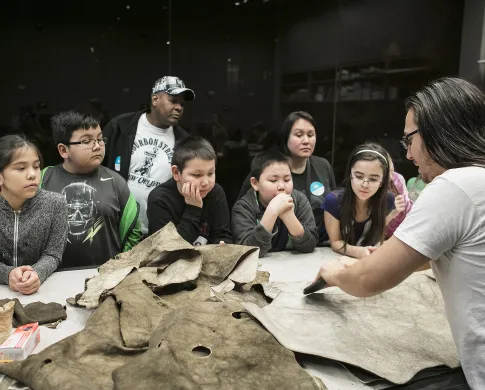
We continued on to Harrington Harbour where our summer visit has become part of the town's annual recurring cycle of events: the arrival of the archaeologists! Harrington Harbour is situated on a small island and has a population of about 300 people, many of whom find work at the dock, in the fish plant (one of the few still operating on the coast), or through the school, an old folks home, or in shops and service sector jobs. Each year near the end of the field season Bill makes a radio broadcast from their local station, and holds public meetings at which he and crew share the summer’s research results. At our public meeting in 2003, 20 percent of the town attended. Strong community support has resulted in local people volunteering to help us with excavations. We also worked with town officials Mayor Paul Rowsell and school official/heritage association president, Keith Rowsell, who are establishing a village heritage interpretation center and special archaeology training programs for the school.
 |
 |
| Pitsiulak in yet another guise as clothes dryer |
|
Harrington Harbour is also where the crew takes showers and obtains hot water to wash clothes the old fashioned way—in a bucket with a scrub brush.
|
|
| Gros Mécatina mystery: House? Enclosure? or Cache? |
|
| |
| |
| |
| |
| |
| |
 |
|
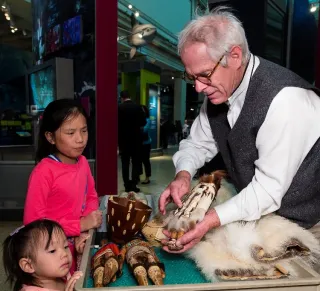
Discussion around our artifact display at Harrington town meeting, 2003 |
 |
| Cristie Boone's laundry day |
|
|
| |
| |
 |
|
Islands of Harrington Harbor and Petit Mécatina
(click on image for enlarged view) |
|
1. Harrington Harbor
2. Havre de la Croix |
3. Petit Mécatina-1 Site
4. Hare Harbour
Basque site |
|
The chart illustrated here locates Petit Mécatina relative to Harrington Harbour. On the map, the deep indentation at the south end of the island is Havre de la Croix—Cross Harbour. East of the north end of the Harbour is Trap Cove, which boasts 4000-year-old Maritime Archaic sites and dwellings on the raised boulder beaches. To the east lies Pointe Antrobus and just north of that, Anse du Petit Mécatina or Little Mécatina Bay, known locally as Hare Harbour, where we found the Basque site and other historic European settlements.
|
|
|
View of PM-1 site area across Trap Cove toward the west |
|
| |
|
 |
| Map of PM-1 longhouse dwelling |
| |
| |
| |
| |
|
|
 |
| Anja Herzog and Carrie Swan draw PM-1 measuring, 2002 |
|
|
|
|

|
| Lena Sharp, Christie Leece, and Anja Herzog map a boulder feature at PM-2, 2003 |
|
 |
| View down the center of the PM-1 longhouse |
|
|
| |
 |
Cristie Boone and Anja Herzog map
PM-1 longhouse, 2002 |
|
|
| |
|
| |
|
 |
|
| The crew shoots in the PM-1 room depressions, 2002 |
|
| |
|
 |
|
| View of Petit Mécatina 1 |
|
| |
|
 |
|
| Drawing of PM-1 slate axe blade |
|
| |
|
| |
|
| |
| |
 |
|
| Rescue at sea: the crew checks out survival suits |
|
Anchoring inside Cross Harbour, the crew hiked across to Trap Cove and began excavating the Petit Mécatina-1 (PM 1) longhouse we had found in 2001.
Measuring 30 m long and 5 m wide, the house was composed of a string of five living compartments, each with a central raised hearth and a floor 20-30 cm below the beach surface. Outside the house were several pits (caches) used for preserving food. A second house paralleled the first and had a large pit forming its northern room.
Artifacts were scarce but a fragment of a grindstone and a facetted ground slate axe were recovered. These are similar to tools recovered from Port Aux Choix and central Labrador Maritime Archaic sites dating to 3,500-4,000 years ago.
These were exciting results because until now no Maritime Archaic longhouse sites had been found south of the central Labrador coast.
Farther east, we found another Maritime Archaic site (PM-2) with a longhouse, a separate bowl-like house structure, and several cache pits, very similar to the complex at PM-1, but we were unable to excavate (and hardly able to map) because of pouring rain. Unlike the Labrador longhouses, which are full of flakes and tools, Québec dwellings are nearly empty and contain only a small number of flakes and tool fragments. One difference is that the Labrador sites are on sandy beaches whereas the Québec sites so far known are on exposed outer coast boulder beaches where small objects easily fall between the rocks where they cannot be recovered.
Before leaving the protected Cross Harbour anchorage, Bill decided we should practice use of the boat’s cold water survival suits. All, except Will, who photographed, and Perry, who supervised, donned the nylon and foam rubber suits and jumped into the frigid water. We quickly found the 'centipede crawl' was the only effective means of propulsion. If we ever really had an emergency, at least we were prepared. |
| |
|
|